
Có thể bạn quan tâm: Hữu Lũng Lạng Sơn Cách Hà Nội Bao Nhiêu Km? Cập Nhật Khoảng Cách Và Thời Gian Đi
A Village Where Clay Becomes Culture
For travelers searching for an introduction to Bát Tràng ceramic village, it is essential to understand that this is more than a place where pots, bowls, and decorative objects are produced. Bát Tràng is a living cultural community where centuries of technical knowledge, artistic creativity, and village life have been passed from one generation to the next. Located in Gia Lâm District, Hanoi, the village has become famous for its distinctive ceramics, resilient pottery traditions, and growing role in Vietnam’s contemporary art scene.
The ceramic products of Bát Tràng are widely recognized for their strength, refined appearance, and remarkable variety. They range from simple household items to sophisticated sculptures, architectural components, tea sets, tableware, and works designed by modern artists. Yet behind every polished bowl or intricately modeled figurine is a long process that begins with humble clay and depends on the skill, patience, and experience of the artisan.
A visit to Bát Tràng offers an opportunity to look beyond the object itself. It allows visitors to observe the relationship between material and human hands, tradition and innovation, and local life and national cultural identity. Whether visiting a traditional workshop, browsing the ceramic market, or walking through the old village, one can gain a deeper appreciation of Bát Tràng as a symbol of Vietnamese resilience and craftsmanship.
Có thể bạn quan tâm: Xe Khách Đi Quảng Ninh Từ Bến Xe Mỹ Đình: Lịch Trình, Giá Vé Và Kinh Nghiệm Đặt Xe
Location and Historical Background
Bát Tràng is situated approximately fifteen kilometers northeast of central Hanoi, near the Thuỷ Tạ River, part of the Red River Delta network. Although it has become increasingly accessible and popular with tourists, the village has retained much of its traditional character. Its streets are lined with family-run pottery workshops, small shops, communal spaces, temples, cafés, and homes where ceramic production continues alongside daily community life.
The village’s pottery history is generally traced back to the medieval period, although the exact beginning of the craft varies according to local historical accounts. The area was once known as Phù Lãng. Under later royal rule, particularly during the development of village-based industries in the early modern period, ceramic production became increasingly important. The name Bát Tràng is commonly associated with a riverside boat landing or boat-building area, reflecting the village’s close connection with waterborne transportation and trade.
During the Lê dynasty, Bát Tràng pottery gained recognition for producing practical vessels, cooking utensils, water containers, roof tiles, and other architectural ceramics. The village benefited from its proximity to Hanoi and major waterways, making it easier for artisans to obtain materials and distribute their products. Communal institutions and royal encouragement also contributed to the expansion of the local craft.
One of the most important traditions connected with Bát Tràng is the story of Emperor Lê Thánh Tông. Local accounts state that the emperor visited the village, praised its products, and supported the ceramic industry. The village temple and traditional ceremonies preserve the memory of this historical relationship. These stories are not merely tourist legends; they play an important role in the identity of Bát Tràng residents, many of whom continue to regard pottery as both an occupation and a family heritage.
Over time, Bát Tràng products expanded beyond basic domestic uses. Artisans began producing more decorative objects, statues, ritual items, and specialized ceramics. During the nineteenth and twentieth centuries, exposure to new forms, techniques, and markets encouraged further development. Traditional workshops continued to make functional vessels, while newer workshops explored portraiture, religious sculpture, tableware, and export products.
This ability to adapt has been central to the survival of Bát Tràng. The village did not preserve its traditions by remaining unchanged. Instead, artisans have repeatedly responded to new needs while maintaining recognizable qualities such as durable clay bodies, attractive glazes, and careful finishing.
Có thể bạn quan tâm: Các Quán Gà Nướng, Cơm Lam Ngon Ở Đà Lạt: Những Địa Điểm Đáng Thử Và Kinh Nghiệm Chọn Món
The Character of Bát Tràng Ceramics
Bát Tràng ceramics are generally associated with high-fired stoneware or closely related ceramic bodies. Compared with some lower-fired earthenware, well-fired Bát Tràng ware can be dense, durable, and resistant to water and heat. These qualities made traditional products especially useful for cooking, storage, serving food, and everyday household activities.
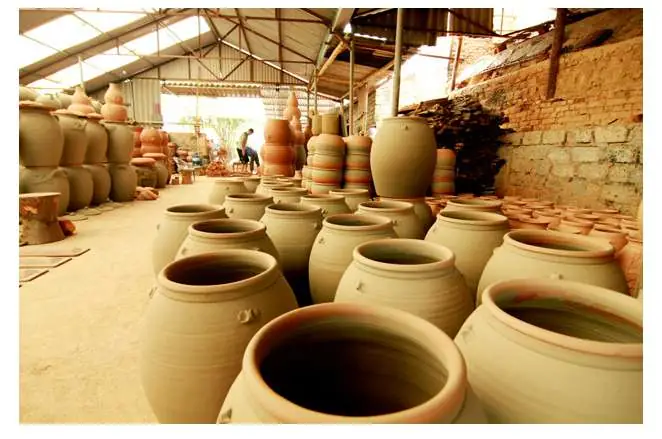
The village is not known for a single uniform style. Instead, its ceramics include numerous shapes, colors, surface treatments, and decorative techniques. Among the most familiar are bowls, plates, cups, teapots, jars, spoons, incense holders, vases, and small containers. More elaborate pieces include human figures, animals, miniature scenes, table ornaments, lamps, and decorative wall objects.
Color is an especially important part of Bát Tràng’s visual identity. Traditional products may feature glazes in green, brown, amber, cream, yellow, blue, black, or white. Some pieces are left unglazed to reveal the natural color of the clay, while others combine multiple glaze tones to create depth and contrast. Crackle patterns, carved details, applied reliefs, and underglaze painting can further distinguish one design from another.
A successful Bát Tràng ceramic is not evaluated only by its appearance. Its proportions, weight, balance, texture, and usability also matter. A bowl should sit comfortably in the hand, a teapot should pour smoothly, and a decorative figure should maintain visual harmony. This combination of function and beauty reflects the village’s long history as a producer of everyday objects rather than pottery made solely for exhibition.
From Clay to Finished Pottery
The process of making Bát Tràng pottery varies between workshops and product types, but it usually includes several connected stages: selecting and preparing clay, forming the object, drying it, refining the surface, applying decoration or glaze, firing the piece, and inspecting the final result.
1. Selecting and Preparing Clay
The first stage begins with suitable clay. Clay may be obtained from deposits in and around the Red River Delta, and its composition can differ according to location. Artisans examine the material for plasticity, color, texture, and firing behavior.
Clay preparation is a physically demanding task. The material is worked, kneaded, and often blended to create a consistent mixture. This process removes unwanted particles, distributes moisture evenly, and helps reduce defects such as cracks. The quality of the prepared clay strongly influences what happens in the kiln. Clay that is too wet may slump during drying, while insufficiently prepared clay may crack or deform during firing.
Some traditional workshops continue to prepare clay largely by hand, while larger operations may use machines to process larger quantities. Even when equipment is introduced, experienced potters still assess the material because no two batches behave in exactly the same way.
2. Forming the Object
After the clay is prepared, the artisan begins forming the desired shape. Round vessels such as bowls, cups, and plates are commonly made on a potter’s wheel. The artisan places a prepared portion of clay on the rotating wheel, opens it, raises the walls, and gradually shapes the vessel with controlled pressure.
Wheel throwing demands physical strength and precise timing. The hands must support the clay without pushing it too far or losing its symmetry. Slight differences in pressure, speed, and moisture can produce variations in thickness and contour. These differences are often accepted as signs of human craftsmanship rather than defects.
Objects with complex or standardized forms may be created using molds. Square containers, teapots, architectural pieces, and detailed sculptures often require a combination of molding, hand-building, trimming, and joining. Artisans may add handles, spouts, feet, lids, or separately modeled decorative elements. Each added component must be attached securely and shaped so that it appears to be part of the original design.
3. Drying and Refining
Fresh pottery contains substantial moisture and cannot be fired immediately. It is placed on boards or shelves and allowed to dry gradually. The drying process must be carefully controlled because uneven drying can cause cracking or warping. Larger pieces may be covered to slow moisture loss, while smaller objects may be turned or repositioned.
Once the clay becomes leather-hard, the artisan may trim the base, refine the rim, smooth rough areas, and correct minor shaping problems. Handles or decorative details may also be adjusted. This stage is often less visible to visitors than wheel throwing or firing, but it is essential to the final quality.
4. Applying Glaze and Decoration
The surface of the dried ceramic is prepared for decoration. Depending on the design, it may be dipped, brushed, or sprayed with glaze. Traditional glazes are formulated to create characteristic colors and effects. Some remain transparent enough to reveal the clay beneath, while others produce a rich, glossy, matte, or variegated surface.
Artisans may also carve patterns, attach reliefs, paint underglaze, or combine several decorative techniques. Modern workshops may use transfer printing, screen printing, or other methods to apply detailed images. Nevertheless, handmade finishing remains common, allowing each object to retain subtle variations that reveal the maker’s touch.
5. Firing the Ceramic
Firing is one of the most dramatic stages. In traditional settings, pottery is placed inside a kiln and heated over an extended period. The temperature, atmosphere, fuel, duration, and arrangement of the pieces must all be carefully managed. Different ceramic bodies and glazes require different firing conditions, with temperatures potentially ranging from around 900 to more than 1,300 degrees Celsius.
Có thể bạn quan tâm: Ngôi Chùa Đúc Hoàn Toàn Bằng Đồng Ở Việt Nam: Khám Phá Chùa Keo Và Nghề Đúc Đồng Cổ Truyền
Small traditional workshops may use wood, coal, or other combustible fuels, while newer facilities may use gas or electricity. More efficient firing systems can reduce fuel consumption and improve control, although they also require investment. The transition to cleaner technologies remains an important issue for the village’s future.
During firing, clay undergoes irreversible physical and chemical changes. Water is removed, the clay body becomes denser, and the glaze melts to form a glass-like surface. A successful firing gives the pottery its characteristic strength, sound, color, and finish. Pieces that are not properly fired may crack, melt, discolor, or become unsuitable for use.
Cooling is equally important. The artisan must allow the ceramic to cool at a suitable rate so that thermal stress does not damage the object. After cooling, the finished pieces are examined for cracks, deformation, glaze faults, and inconsistencies. Only then are they selected for sale, exhibition, or use.
Bát Tràng in the Modern Era
Today, Bát Tràng is both a traditional pottery village and a center for contemporary ceramic design. Many young artists and designers have returned to or entered the industry with new ideas. They create tableware, home decorations, fashion accessories, large installations, and pieces that combine local techniques with modern aesthetics.
This contemporary movement is helping Bát Tràng move beyond the image of a village producing only traditional souvenirs. Young creators are experimenting with bold colors, unusual forms, social themes, sustainable production, and collaborative design. Some have established their own brands, while others work with established workshops and family businesses.
The relationship between traditional and modern ceramic practice is not always straightforward. Modern artists may question inherited standards, while older artisans may worry that innovation will dilute cultural identity. However, adaptation is not the same as abandonment. Bát Tràng’s strongest traditions have always developed through the introduction of new tools, products, and artistic ideas.
New technologies can also support the craft. Improved kilns can reduce energy use and defects. Digital designs and online sales allow workshops to reach national and international customers. Social media enables individual artisans to tell their own stories rather than relying entirely on intermediaries. At the same time, digital marketing creates pressure to imitate whatever is currently popular, so workshops must avoid sacrificing quality and originality for speed.
A Living Cultural Community
Bát Tràng is more than a production site. It is a community organized around family knowledge, neighborhood relationships, religious traditions, and shared cultural memory. Pottery workshops are often closely connected to household life. Children may grow up surrounded by clay, tools, kilns, and conversations about design, while experienced artisans teach techniques to relatives and apprentices.
The village also has a strong communal dimension. The communal house and village temple remain important landmarks for residents and visitors. They help preserve local stories and reinforce the sense of belonging shared by successive generations. Ceramic objects used in festivals, family ceremonies, religious practices, and community celebrations also carry meanings beyond their commercial value.
The pottery market is another central part of village life. Here, visitors can find products at many price points, from affordable handmade cups to collectible works by recognized artists. Bargaining may occur in some circumstances, but visitors should remember that many artisans are small-scale producers for whom every sale represents part of their livelihood. Respectful purchasing can directly support workshops and local families.
Bát Tràng’s craft is therefore best understood as a living intangible heritage. It continues through knowledge, practice, and everyday creation rather than remaining fixed in the past.
Visiting the Village
A visit to Bát Tràng can be rewarding for travelers, researchers, students, art enthusiasts, and families. The most common way to reach the village is by road from central Hanoi, although travel time varies with traffic. Visitors may also approach by water, which provides a distinctive view of the settlement’s historical relationship with river transport.
A typical visit includes walking through the pottery streets and visiting the Bát Tràng communal area. The ceramic market offers an opportunity to compare shapes, glazes, and craftsmanship. Visitors who are genuinely interested in the craft may also arrange to enter a workshop and speak with an artisan.
Observation should always be conducted respectfully. Artisans are working professionals, not simply performers for visitors. It is best to ask before photographing people, their work areas, or sensitive processes. Touching unfinished pieces without permission can damage them, and buying directly from a workshop is preferable when practical.
Visitors can learn by asking questions about the clay, the firing process, glaze recipes, design decisions, and the history of the workshop. Such conversations are often more informative than simply purchasing a product. The experience becomes a meeting between two cultures rather than a stop at a souvenir market.
Challenges Facing the Village
Despite its international recognition, Bát Tràng faces many challenges. Competition from inexpensive mass-produced ceramics is one of the strongest pressures on small workshops. Factories elsewhere can produce similar forms more quickly and often sell them at lower prices. Handmade Bát Tràng products must therefore communicate the value of their durability, creativity, and cultural origin.
Tourism can support the local economy, but it can also disrupt village life. Excessive noise, waste, traffic, and commercial development may threaten the atmosphere that makes Bát Tràng special. If most shops become identical souvenir outlets, visitors may see the village as a commercial stop rather than a meaningful cultural destination.
Environmental concerns are equally important. Clay preparation can generate dust, glazing can involve chemical materials, and traditional kilns may create smoke and carbon emissions. Workshops must improve ventilation, waste management, water use, and kiln efficiency without placing an excessive financial burden on small producers.
Another challenge is the migration of young people. Many young residents have more opportunities in large cities or other industries. The disappearance of young artisans would weaken the village’s capacity to preserve traditional knowledge while also making it more difficult to develop innovative ceramic design.
Protecting the Future of Bát Tràng
The future of the village depends on a balance between conservation and development. Traditional techniques should be documented through careful recording, apprenticeships, and community participation. Experienced potters can teach younger artists not only practical skills but also approaches to proportion, glaze sensitivity, firing judgment, and quality control.
At the same time, Bát Tràng needs opportunities for young designers to experiment. Support for craft education, cultural programs, small grants, and fair market access can help creators build viable careers without producing repetitive souvenirs.
Cleaner kilns, responsible clay sourcing, safer glaze handling, and improved workshop ventilation would make the industry more sustainable. Cooperative marketing can also help small workshops reach customers directly, reducing dependence on intermediaries and preserving more of the value for artisans.
Tourism should be managed according to the principles of responsible travel. Visitors should be encouraged to learn about the history of the village, support local makers, respect residents, and purchase authentic products. Regulating excessive commercial development and protecting important communal spaces would help maintain Bát Tràng’s cultural character.
Perhaps most importantly, the village’s future should be shaped by the people of Bát Tràng themselves. Outside investment, government support, and tourist interest can assist, but decisions about the ceramic craft must also be guided by local knowledge and the needs of artisan families.
Conclusion
An introduction to Bát Tràng ceramic village reveals a community in which pottery is simultaneously art, industry, heritage, and way of life. For centuries, villagers have transformed locally available resources into useful and beautiful objects. Their work reflects Vietnam’s long ceramic tradition while also demonstrating an ability to adapt to changing markets and tastes.
The enduring appeal of Bát Tràng lies in the combination of material, history, and human skill. Each object carries traces of the clay preparation, shaping, drying, glazing, and firing that brought it into existence. The village’s ceramics may be found in ordinary homes, restaurants, temples, galleries, and international exhibitions, but their significance remains rooted in the community where the craft began.
By protecting traditional knowledge, encouraging young designers, adopting cleaner production methods, and welcoming visitors responsibly, Bát Tràng can continue to thrive. Its future should not be imagined as a frozen picture of the past, but as a living tradition moving forward. Bát Tràng does not simply preserve the Vietnamese past; it continues to create culture with every piece that leaves the kiln.